Make your wholesale requirement easier to understand.
Seven things worth gathering before you write an enquiry, each with the reason it matters and a short list of what to collect. Work through it once and the enquiry writes itself.
This is a preparation guide, not a specification sheet. Nothing here asks you to know anything technical about the part.
The seven sections map directly onto the fields in the enquiry form, so anything gathered here can be transferred straight across.
A printable summary checklist sits at the foot of the page.
Half an hour here saves a week of correspondence
Every question a supplier has to ask is a round trip. The purpose of this page is to answer as many of them as possible before the first message goes out.
There is nothing technical in what follows. The seven sections ask for things a buyer already has or can easily obtain: what the vehicle is, what the requirement covers, some photographs, a quantity, a destination, whatever is already known about the part, and any constraints. What makes the difference is not expertise — it is having gathered these in one place before writing rather than producing them one at a time in response to questions.
Read the sections that apply to your situation. Not all seven will, and none of them is compulsory. But an enquiry that covers most of them can usually be answered in a single reply, and that is the entire point.
Guide index
Vehicle / Application
The single detail that turns a category into a part.
A seatbelt requirement without a vehicle is a requirement without a subject. Almost nothing specific can be said in reply to an enquiry that names only a product type, because the same product type covers items that differ substantially between vehicles and between positions within the same vehicle.
Give the vehicle first, then the position. Make and model, plus the model year or generation if you know it. Then front or rear, which side, and whether the position is an outer seat or a centre seat. If the vehicle has been configured for a particular purpose, or the seating layout is not the standard one, say so — that is exactly the sort of thing a supplier cannot infer.
- Vehicle make and model
- Model year or generation, if known
- Front or rear seating position
- Which side of the vehicle
- Anything non-standard about the layout
Product Requirement
What you are asking for, stated so it could only mean one thing.
Be explicit about scope. A complete seatbelt, a seatbelt assembly, an individual component and a replacement for something already fitted are four different requirements, and an opening message that does not distinguish between them will need a reply that asks which one you meant.
The most useful sentence you can write here is the one that says what is not included. Buyers routinely assume that an assembly includes a particular piece, or that a component enquiry implies the surrounding hardware. Stating the boundary explicitly costs one line and removes the most common source of misunderstanding in the whole exchange.
- Complete belt, assembly, component or replacement
- What is inside the scope of the requirement
- What sits outside it
- Like-for-like match, or would an equivalent serve
- Any constraint you already know about
Photographs
The part of the enquiry that does the most work for the least effort.
Where the part is accessible, photographs outperform description consistently and by a wide margin. Components vary in ways that ordinary language handles badly — the angle of a stem, the shape of a slot, the depth of a moulding — and two parts described identically in a sentence can be obviously different in an image.
Photograph the part in place before it is disturbed. The routing of the webbing and the position of the anchor points are frequently what identifies a part, and both are lost the moment it comes out. Then photograph it removed, from more than one angle, and take a close image of any markings even if they look illegible — they often read better on a screen than in a vehicle footwell.
- The part in place, before removal
- The surrounding area and anchor points
- The part removed, from several angles
- Any markings, labels or stamped characters
- A wide shot for context, even if it feels redundant
Quantity
Volume changes the answer, so it belongs in the first message.
Wholesale is a conversation about volume. A requirement for a few units and a requirement for several hundred are handled differently from the outset, and a supplier who does not know which they are reading cannot respond usefully to either. There is no threshold below which a quantity becomes not worth stating.
Where a requirement covers more than one part, give the breakdown rather than an aggregate. A single total conceals the fact that it spans several different items, and that concealment is discovered later at everyone’s expense. If the figure is genuinely uncertain, an honest range with a note that it is a range beats a precise number that turns out to be wrong.
- How many units in total
- Broken down by position or part where they differ
- One-off requirement or recurring
- If recurring, roughly how often
- Whether the figure is firm or an estimate
Destination
Where the goods are going shapes the answer before anything moves.
Packing, documentation and cost are all downstream of the destination, and all of them are easier to discuss at the enquiry stage than after a requirement has been agreed. Buyers frequently hold this back on the assumption that it is a later concern; in practice it is one of the earlier ones.
A city and state is usually enough for a requirement within India. For an export requirement, a country and, where it is known, a port. If there is a date the requirement is working towards, include it here — timing and destination are usually discussed together.
- City and state, for a domestic requirement
- Country and port, for an export requirement
- Any date the requirement is working towards
- Packing or documentation requirements at the destination
- Who receives the goods at that end
Existing Information
Anything you already know about the part, however partial.
Buyers routinely withhold information because it seems incomplete — a partially legible marking, an old reference from a previous purchase, a supplier name they are not certain about. Partial information is still information, and in identification work a fragment frequently narrows a search that a full description would not.
Include anything you have: markings on the webbing or hardware, labels, a previous order reference, the name of whoever supplied it last time, or a note of what has already been tried and did not work. The last of these is particularly valuable and is almost never volunteered.
- Markings on the webbing or hardware, even partial
- Labels or printed text of any kind
- A previous reference or order number
- Who supplied the part previously, if known
- What has already been tried, and what happened
Additional Requirements
The constraints that are cheaper to state than to discover.
This is the section for everything that does not fit the six above: a timing constraint, a packing preference, a documentation requirement, an internal approval process that affects how the conversation has to run, or a difficulty that has come up on a previous requirement of the same kind.
The general principle is that a constraint stated early is a constraint accommodated cheaply, and a constraint discovered late is a problem. If something is going to matter at any point in the conversation, it is almost always better to raise it in the first message than to wait until it becomes relevant.
- Timing constraints or working-towards dates
- Packing or labelling preferences
- Documentation the destination requires
- Anything that has caused difficulty before
- Preferred contact method and working hours
Why a photograph beats a paragraph
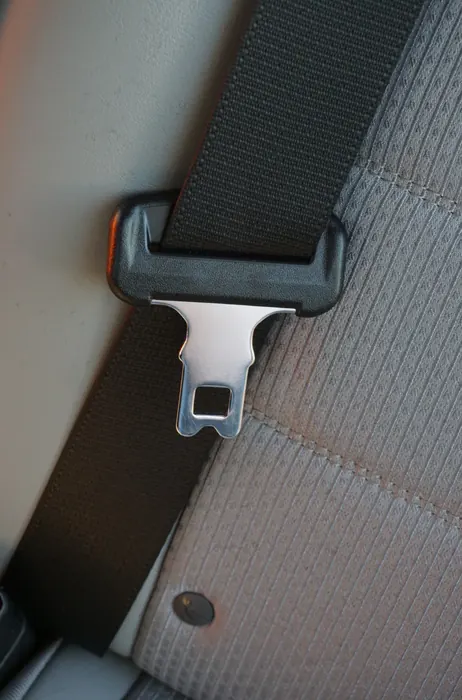
If you take one thing from this page, take this: photograph the part before you describe it, and photograph it before it is removed.
The difficulty with describing seatbelt hardware in words is that the vocabulary is imprecise and shared unevenly. A buyer and a supplier can use the same term for different things and both be reasonable. A photograph is not subject to that problem: it shows what is there, including the details neither party thought to mention.
The second point matters just as much. A part photographed in place shows how the webbing was routed, where it anchored and what it sat against. All of that is identifying information, and all of it disappears the moment the part is out of the vehicle. It takes thirty seconds to photograph something before removing it, and there is no way to recover the image afterwards.
A workable sequence
- Open the door and photograph the whole seating position.
- Photograph where the belt anchors, at each anchor point.
- Photograph the latch plate and the buckle receiver together.
- Photograph any markings close up, with the light behind you.
- Only then remove the part, and photograph it again on a plain surface.
The whole guide,
on one sheet.
Everything above, compressed to a single checklist. Print it, or keep it open in a tab while you write — this page is styled to print cleanly on one page.
01 · Vehicle / Application
Vehicle make and model · Model year or generation, if known · Front or rear seating position · Which side of the vehicle · Anything non-standard about the layout
02 · Product Requirement
Complete belt, assembly, component or replacement · What is inside the scope of the requirement · What sits outside it · Like-for-like match, or would an equivalent serve · Any constraint you already know about
03 · Photographs
The part in place, before removal · The surrounding area and anchor points · The part removed, from several angles · Any markings, labels or stamped characters · A wide shot for context, even if it feels redundant
04 · Quantity
How many units in total · Broken down by position or part where they differ · One-off requirement or recurring · If recurring, roughly how often · Whether the figure is firm or an estimate
05 · Destination
City and state, for a domestic requirement · Country and port, for an export requirement · Any date the requirement is working towards · Packing or documentation requirements at the destination · Who receives the goods at that end
06 · Existing Information
Markings on the webbing or hardware, even partial · Labels or printed text of any kind · A previous reference or order number · Who supplied the part previously, if known · What has already been tried, and what happened
07 · Additional Requirements
Timing constraints or working-towards dates · Packing or labelling preferences · Documentation the destination requires · Anything that has caused difficulty before · Preferred contact method and working hours
Gathered everything? Write it down.
The enquiry form arranges these seven sections in order, so anything you have collected here transfers straight across without rewriting.